The Morse Code Alphabet: How to Read, Write, and Learn It
Most people can learn the full morse code alphabet in one to two weeks at 20–30 minutes of focused daily practice, hold a basic exchange within a month, and reach a practical receiving speed (15–20 words per minute) in two to three months of consistent practice — recognizing a handful of letters, or SOS specifically, takes just a few minutes.
Morse code has outlived the telegraph, the telegram, and its own retirement from maritime regulation. Amateur radio operators still use it daily, because a signal built from two symbols cuts through noise that defeats voice transmission entirely. This is a practical guide to the alphabet itself: how the code is structured, the timing that separates letters from words, the numbers and punctuation people forget exist, and the learning method that actually works.
The alphabet, and the logic inside it
The letters run: A .-, B -..., C -.-., D -.., E ., F ..-., G --., H ...., I .., J .---, K -.-, L .-.., M --, N -., O ---, P .--., Q --.-, R .-., S ..., T -, U ..-, V ...-, W .--, X -..-, Y -.--, Z --..
Look at the pattern: E is a single dot and T is a single dash, while rare letters like Q and Y take four symbols each. That's deliberate — Samuel Morse and Alfred Vail reportedly surveyed a printer's type case to find which letters English uses most, and assigned the shortest codes to them. It's frequency-based compression, invented a century before information theory formalized the idea.
Numbers and punctuation
Digits follow a clean five-symbol pattern: 1 is .---- and each subsequent number converts one more dash to a dot, through 5 (.....), then reverses — 6 is -...., up to 0 as -----. Once you see the symmetry, all ten come almost free.
Common punctuation exists too: period .-.-.-, comma --..--, question mark ..--.., slash -..-., and the @ sign .--.-. (added in 2004, the first new character in decades). Our Morse Code translator handles all of them in both directions.
Timing is the real code
Written morse hides the part that matters. Everything is measured in one base unit: a dot is one unit of signal, a dash is three. The gap between symbols within a letter is one unit, between letters three units, and between words seven units.
That's why timing — not symbol shape — is what you're actually learning to hear. Two dots separated by one unit is I; the same two dots separated by three units is E followed by E. In writing, the convention is to separate letters with spaces and words with a forward slash, which is what our translator outputs.
How to actually learn it
Do not learn from a printed chart. Almost everyone tries, and almost everyone stalls, because visually memorizing dot patterns builds a translation step — hear sound, picture dots, decode letter — that caps you around five words per minute and is painful to unlearn.
The proven approach is the Koch method combined with Farnsworth timing. Koch: start with just two characters sent at full target speed, and only add a third once you're hitting 90% accuracy. Farnsworth: send the individual characters fast while stretching the gaps between them, so you learn each character's rhythm as one sound from the beginning, then gradually shrink the gaps. Twenty focused minutes a day beats two-hour weekend sessions — this is muscle memory, not knowledge.
SOS and the abbreviations that survive
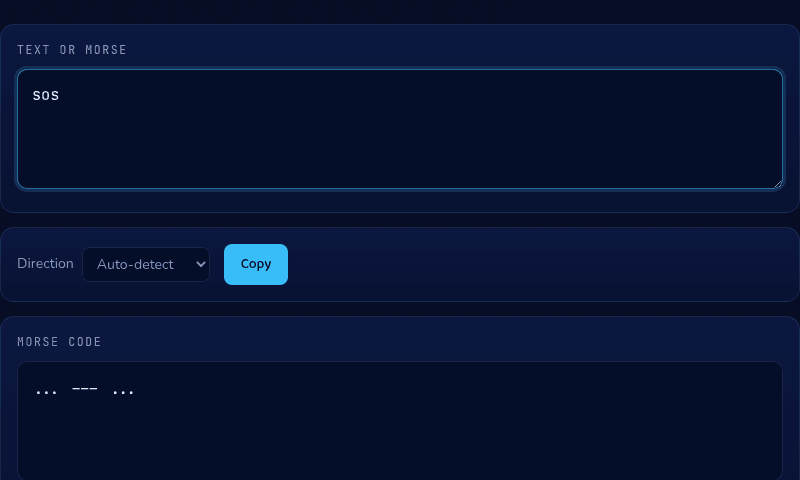
SOS is ... --- ..., sent as one unbroken sequence rather than three letters. It was chosen in 1906 for being unmistakable in sound, not as an abbreviation — "Save Our Ship" and "Save Our Souls" were invented afterward.
Operators also built a shorthand that still shapes radio culture: CQ (-.-. --.-) means a general call to anyone listening; 73 (--... ...--) means best regards and is still typed at the end of ham radio messages worldwide; SK signals the end of a contact. Maritime services officially retired morse distress calling in 1999, but amateur operators kept the mode alive precisely because it works when nothing else does.
Sending it: light, sound, and taps
Morse is medium-independent, which is its quiet superpower. The same timing works as sound from a buzzer, flashes from a torch or car headlights, taps on a pipe or wall, or pulses of radio energy. Prisoners of war have used tapped morse through walls; pilots have identified navigation beacons by their morse idents; survivors have signalled aircraft with a mirror.
For visual signalling the convention is a short flash for a dot and a flash roughly three times as long for a dash, keeping the same gap rules. Because only the ratio matters, you can send slowly to a beginner and quickly to an expert without changing the code at all.
Practice with a translator
The fastest feedback loop while learning: write out what you think a sequence says, then check it. Our Morse Code translator converts in both directions and auto-detects which one you need — paste dots and dashes to decode, or type text to encode. It handles letters, numbers, and punctuation, and normalizes the typographic · and − characters other sites produce. For a modern parallel, our Binary Translator shows how the same idea works with ones and zeros. Morse code isn't just a learning exercise either — it's still genuinely in use today in amateur radio, aviation, and emergency signaling.