Glitch Text Generator: How Zalgo Text Actually Works
Yes, glitch text — also called zalgo text — is completely safe to copy and paste: it's made entirely of standard Unicode characters, not code, scripts, or anything that can execute on your device. Type a word into a glitch text generator and it comes back looking possessed — letters dripping with marks, stacked symbols crawling above and below the line, like the text itself is corrupting in front of you. It looks like broken rendering. It isn't.
This guide explains the whole trick: the Unicode mechanism behind glitch text, where the name zalgo comes from, which platforms render it and which fight back, and how to use it without tripping spam filters, wrecking accessibility, or bogging down someone's phone.
It's not a font — it's combining marks
Unicode, the standard that assigns a number to every character computers can display, includes several hundred "combining diacritical marks": accents, tildes, hooks, strokes, and dots that don't stand alone but attach to the character before them. They exist because the world's languages need them — é is really two characters, a plain e followed by a combining acute accent, fused by your device's text renderer into one glyph.
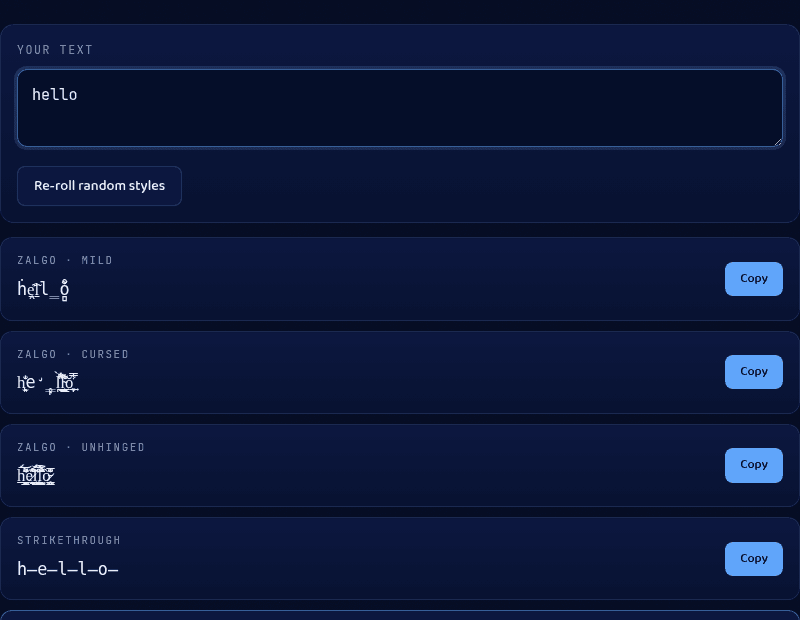
The system has a property nobody planned around: there's no hard limit on how many marks you can attach to a single letter. Attach one and you get an accent. Attach thirty — some floating above, some striking through the middle, some hanging below — and you get a letter that appears to be melting. A glitch text generator is just an engine that picks random marks from the above, middle, and below groups and stacks them on every character you type.
Because every mark is a legitimate Unicode character, the result is still plain text in every technical sense. It copies, pastes, transmits, and stores exactly like normal writing. No images, no custom fonts, no HTML — which is why it works in places that strip all formatting.
Why it's called zalgo text
The name comes from an internet-horror meme that spread through forums and comics communities around 2009. Zalgo was a fictional creeping corruption — "he who waits behind the wall" — and edited comics showing his influence used distorted, dripping text as the visual signature. The look needed a technique, the combining-mark trick fit perfectly, and the two became permanently associated.
Today the same output goes by many search names: zalgo text, glitch text, cursed text, corrupted text, demonic text, creepy text. They're all the identical mechanism at different intensities. Mild versions read as stylishly broken; heavy versions become genuinely illegible, which is usually the point.
Where glitch text works — and where it gets stripped
Most modern platforms render zalgo faithfully: Discord, X, Reddit, Telegram, WhatsApp, Instagram captions and comments, Twitch chat, and the majority of games with Unicode-capable chat. If the platform displays é correctly, it can technically display zalgo — the question is whether it chooses to.
Some services actively limit it. Rendering engines may cap how far marks can extend so stacked zalgo can't overlap other users' messages (Twitch and several games do this — your text stays intact but displays flattened). Others strip combining marks entirely in specific fields: username and display-name forms are the most common casualty, since names feed into notifications, search, and moderation tooling. YouTube normalizes aggressively in comments. None of this damages your text; the platform is refusing to display it fully.
The practical rule: heavier intensity, fewer surviving platforms. If your text gets flattened or rejected, step down to a mild version, or switch to a single-mark style like strikethrough or underline — those use just one combining character per letter and survive almost everywhere.
The etiquette and accessibility side
Two cautions worth knowing before you paste a wall of corruption into a group chat. First, moderation: because zalgo was historically used to disrupt layouts and flood channels, some communities treat heavy zalgo as spam by policy, and automated filters may flag messages that are mostly combining marks. Decorating your own bio is fine everywhere; flooding shared spaces is what gets moderated.
Second, accessibility: screen readers announce combining marks, so a zalgo word can be read aloud as a long stream of technical character names — genuinely unpleasant for blind and low-vision users. Keep glitch text out of anything meant to be broadly readable: no essential information, no link text, no alt text. Decoration only.
Third, performance: stacking hundreds of combining marks on a single word is rare but possible, and rendering that many marks can measurably slow down older phones or lower-powered devices when the text scrolls into view. It's not a security issue — nothing executes — just a rendering cost. The three intensities in the generator below (Mild, Cursed, Unhinged) stay well under that range; it only becomes a concern with generators that let you stack marks manually into the hundreds.
Can you convert glitch text back to normal?
Yes, and it's the mirror of creating it: strip every combining mark and the original letters remain untouched underneath. Programmers do this with Unicode normalization (decompose the text, remove the mark category, recompose). If you've received cursed text and want to read it, pasting it into a plain-text editor with a "remove diacritics" function also works. The base message was never destroyed — just buried.
Make your own in one click
Our Glitch Text tool generates a whole feed of styles from one input: three zalgo intensities (Mild, Cursed, Unhinged) plus strikethrough, slashed, wavy, X-cross, fireworks, and other combining-mark effects — each with its own copy button, with a re-roll for fresh randomization. Everything runs in your browser; nothing you type is sent anywhere. Pair it with the Fancy Text tool if you want stylish rather than cursed. If you spotted glitch text on someone *else's* profile instead of making your own, see what that corrupted-looking text actually is, and whether it's safe.